
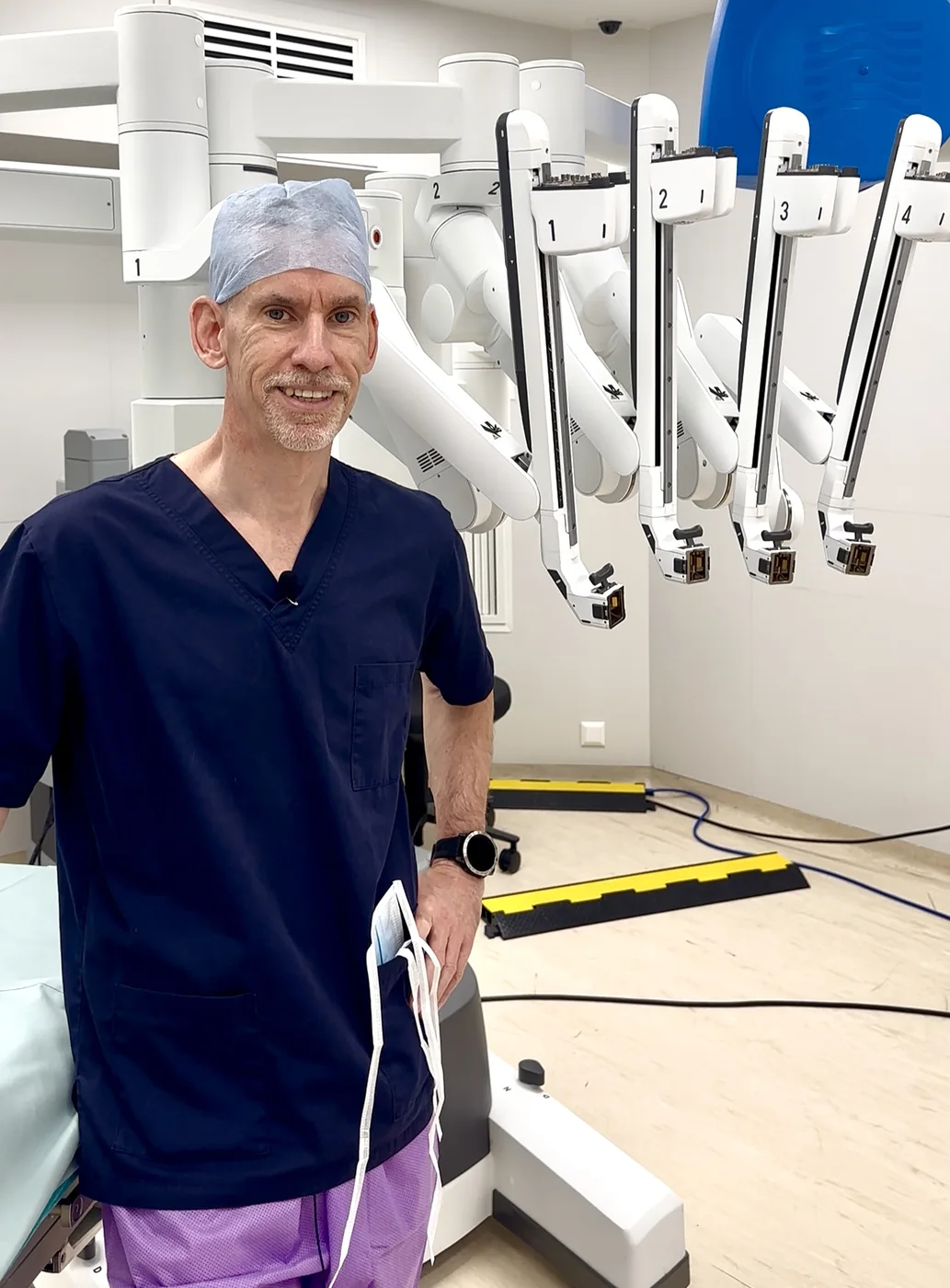
Why can robot-assisted surgery be useful?
- magnified three-dimensional surgical view
- fine instruments with a wide range of motion
- precise dissection in confined anatomical spaces
- minimally invasive access
- the possibility of favourable early recovery in selected procedures
The magnitude of these benefits is not the same for every patient, and technology alone does not determine the surgical result.
Multiport and single-port robotic surgery – what is the difference?
“Robotic surgery” does not refer to a single technical setup. Current systems include multiport and single-port (SP) platforms. Both are fully controlled by the surgeon, but they reach the operative field in different ways.
Multiport system
- the camera and instruments enter through several separate abdominal ports
- the robot uses multiple independent instrument arms
- the architecture provides broad anatomical access and flexibility across different operative directions
- it is an established approach across a wide range of urological robotic procedures
Single-port (SP) system
- the camera and several wristed instruments pass through one main access port
- a single robotic arm introduces the instrument channel, with the instruments articulating separately inside the body
- can be particularly valuable with compact or alternative access routes, for example in certain peritoneum-sparing urological procedures
- it requires different operative planning and specific technical expertise
Robot-assisted prostate surgery
The magnified view and fine instruments can support precise dissection around the prostate. The extent of nerve sparing, however, must always be guided by tumour location and extent.
Robot-assisted radical prostatectomy
Robot-assisted kidney surgery
The technology can be especially useful for partial nephrectomy, where precise tumour excision may need to be followed by reconstruction of the remaining kidney.
Robot-assisted partial nephrectomy
Myth or reality?
The surgeon performs the operation. The system translates the surgeon's movements to the instruments and makes no independent decisions.
The appropriate approach depends on the disease, the patient's condition and the surgical strategy.
It is still surgery and therefore carries risks. Precision technology does not eliminate complications.
Outcomes depend on patient selection, strategy, surgical experience and disease characteristics together.
Is everyone suitable for robotic surgery?
Not necessarily. Tumour size and location, previous operations, comorbidities and anatomical factors can all influence the decision.
This information is general and does not replace an individual medical examination or personalised treatment recommendation.